No Mail, Low Morale.
Warrington’s article highlights the overlooked history of the 6888th Central Postal Directory Battalion, the only all-Black, all-female U.S. Army unit deployed overseas during World War II. This article provides a concrete example of how women asserted authority and competence in a male-dominated institution before formal gender-integration laws such as the 1948 Women’s Armed Services Integration Act. Warrington’s work shows how the 6888th challenged racial and gender norms by completing essential military work under difficult conditions. I plan to connect the battalion’s service to broader changes in military policy, showing that the effectiveness of women like the 6888th helped lay the groundwork for later integration efforts.
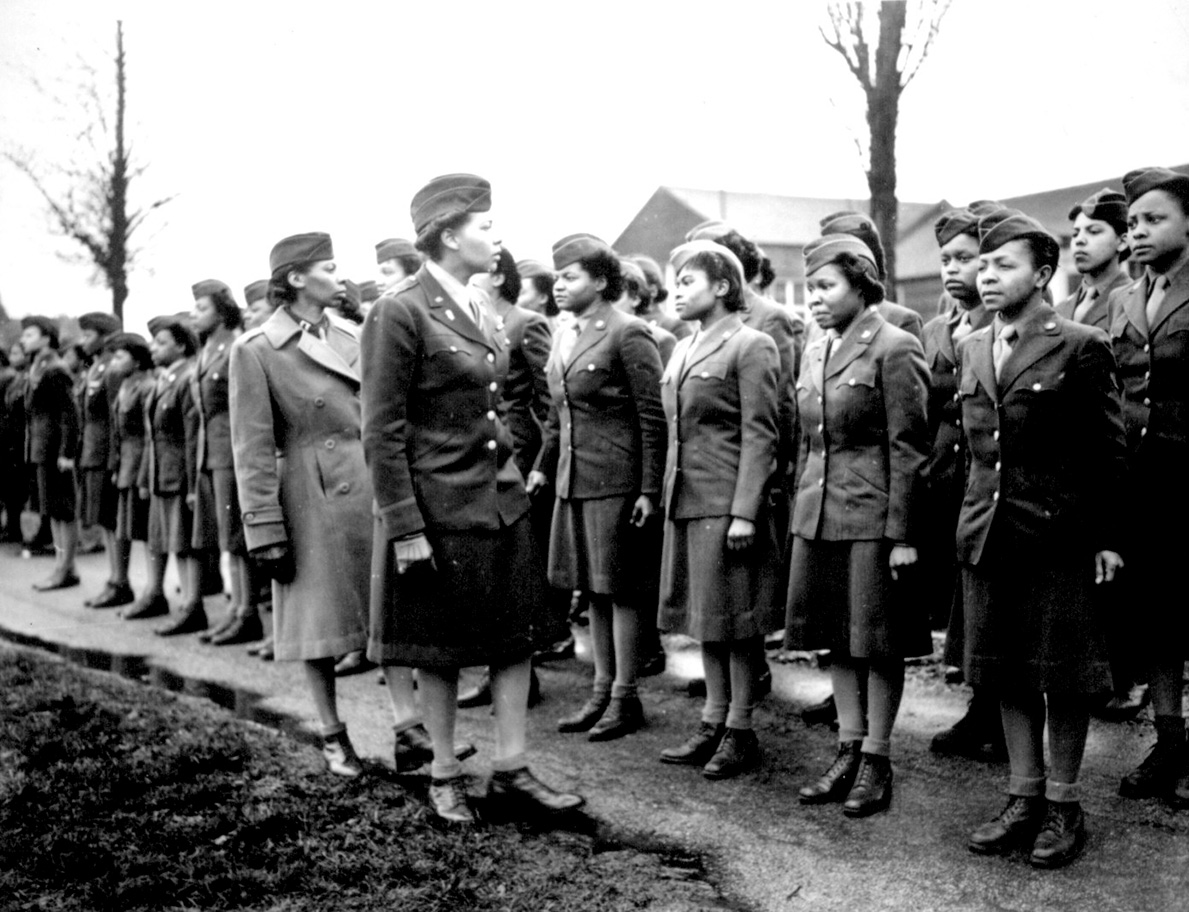
In the shadow of war, when letters from home meant hope, the women of the 6888th Central Postal Directory Battalion took on a mission no one else would. In this photograph taken on February 15, 1945, Battalion commander Maj. Charity Adams, and executive officer Capt. Abbie Noel Campbell stand inspecting the first soldiers of the 6888th to arrive in England, symbolizing the leadership and discipline that defined the unit from the very beginning. As the only all-Black, all-female U.S. Army unit deployed overseas during World War II, the battalion confronted not only the logistical nightmare of a years-long mail backlog but also the weight of racism, sexism, and institutional doubt. Under Adams’s command, the women were expected to maintain military precision while preparing to tackle one of the most overwhelming administrative challenges of the war. They were given what seemed like an impossible task, the sorting of years of undelivered mail for millions of service members stationed across Europe, restoring an essential connection between soldiers and their families back home.
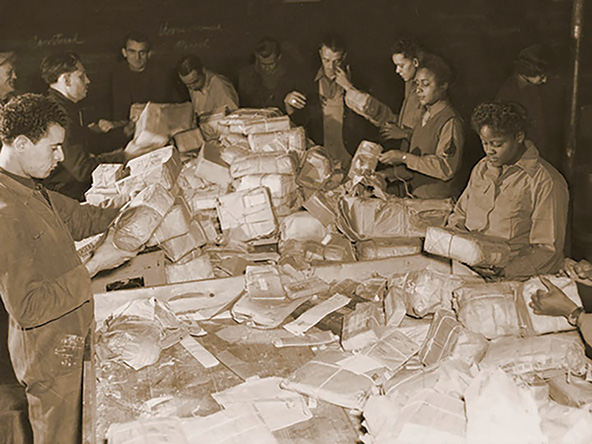
"With World War II raging on, the soldiers of the 6888th were given six months to sort and deliver the mail—they did it in three months." (Warrington) Their success demonstrated exceptional organization, discipline, and determination despite the limited recognition they received at the time. The battalion’s achievements also came during a period when women were still fighting for official recognition within the military, years before the Women’s Armed Services Integration Act of 1948 opened the door for women to serve permanently in the armed forces. By overcoming both racial and gender barriers, the women of the 6888th proved that Black women could not only serve but excel in critical military operations.
French civilians and soldiers from the 6888th sort mail in the spring of 1945. (Photo courtesy of the U.S. Army Womens Museum)